“Beyond Gold: 15 Real Barter Items That Will Matter Most After a Collapse.”
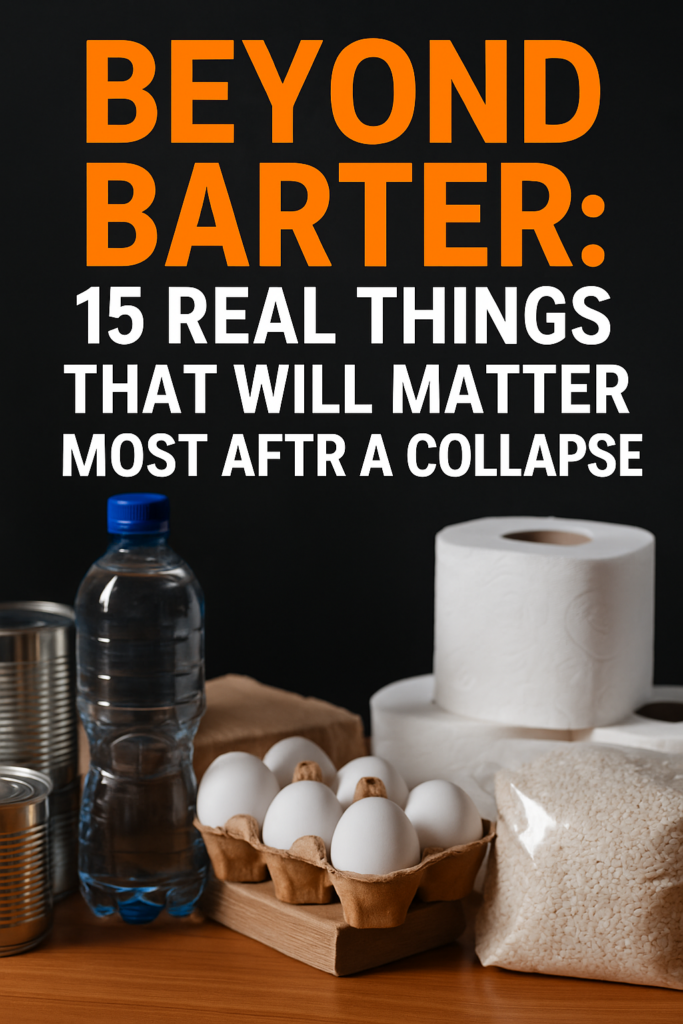
Estimated Reading Time: 10-12 minutes
Audience: Self-reliance seekers, families, critical thinkers, and those looking to prepare—not panic.
When people think of wealth, they often think of gold, bank accounts, or stocks. But history—and common sense—tells us something different when times get tough.
When systems collapse, currency loses its value almost overnight. But life doesn’t stop. People still need to eat. They need clean water, medicine, safety, and warmth. The real question becomes: What holds value when the grid goes down or trust in money disappears?
Here’s a wake-up call: gold might sparkle, but you can’t eat it. You can’t disinfect a wound with it. And it certainly won’t keep your family warm during a long winter.
So, what will be worth more than gold?
Let’s dive into 15 essential items that become life’s real currency during a crisis—and why you should start thinking about them now.
1. Clean Water and Filtration Tools
Water is life. Without it, we’re done in three days. But in a disrupted world, water infrastructure can collapse fast.
Stocking bottled water is one step, but owning portable filtration tools (like LifeStraw’s or gravity-fed systems) gives you long-term safety—and bartering power. A single filtration device could trade for days’ worth of food or security.
💡 Tip: Learn how to create DIY water filters using charcoal, sand, and cloth. Knowledge becomes barter, too.
2. Non-Perishable Food
Canned goods, beans, rice, oats, peanut butter, jerky, and freeze-dried meals will become survival staples. When grocery shelves are empty, calories become currency.
Having extra means you’re not just surviving, you’re able to trade or help others.
3. Medical Supplies
When pharmacies are closed, and hospitals are overwhelmed or non-operational, even simple items like:
- Bandages
- Antiseptics
- Pain relievers
- Antibiotics
- Thermometers
- Insulin
…become high-value assets.
“A bottle of ibuprofen will trade better than silver when your neighbor’s child has a fever.”
4. Fuel and Energy
Gasoline. Propane. Firewood. Charcoal. Lighters. Batteries. Solar chargers.
They all have power, warmth, light, and the ability to cook. Fuel isn’t just a luxury; it’s a necessity. A few gallons of gasoline might be worth more than an ounce of gold at the right moment.
🔥 Batteries, especially rechargeables with solar panels, can keep communication and safety gear running—immense barter value.
5. Ammunition and Self-Defense Tools
Like it or not, security becomes a concern in uncertain times. Ammunition has historically been used as trade currency in war zones. It doesn’t go bad. And it always has a buyer.
But don’t just stock know how to use it safely and responsibly.
6. Tools and Repair Gear
Hand tools like hammers, screwdrivers, nails, duct tape, and multi-tools enable people to fix what breaks.
In a world without Home Depot, your old toolset becomes a prized asset.
🧰 A box of screws or a working shovel might be worth far more than a gold coin when someone needs to rebuild a shelter.
7. Soap and Hygiene Products
Disease spreads fast when sanitation collapses. Soap, bleach, toothpaste, feminine products, diapers, and even toilet paper will be traded like treasure.
A bar of soap may sound ordinary now, but it might save lives later.
8. Comfort Items
Cigarettes, alcohol, coffee, sugar, tea, chocolate, and spices. These aren’t essential to survival, but they provide comfort, routine, and even dignity.
🧂 “A spoonful of sugar or a hot cup of tea in the dark can change someone’s whole outlook.”
These items boost morale—and become incredibly valuable trade goods.
9. Batteries and Light Sources
Once the power is out, batteries power everything from flashlights to radios to medical devices.
Store a mix of AA, AAA, D, rechargeable, and lithium batteries. Include headlamps, lanterns, solar-powered lights, and crank radios.
10. Baby Supplies
Baby formula, diapers, wipes, rash creams. Families with infants will be in desperate need of these supplies—and they’ll trade dearly for them.
If you don’t have children, you can keep a small stockpile to barter or offer compassionately.
11. Seeds and Gardening Tools
When the food supply dries up, growing your own becomes survival—not just a hobby. Heirloom seeds are best because they can be replanted.
Start learning now. A tomato seed might one day mean weeks of nourishment.
12. Warm Clothing and Blankets
When the heat goes out, staying warm becomes top priority. Extra boots, socks, thermal blankets, gloves, and wool sweaters will become essential.
🔁 Think in layers, stock extras for trade and gifting.
13. Communication Devices
Hand-crank radios, shortwave receivers, and walkie-talkies let people stay connected. Information becomes power when chaos reigns.
📻 “A person with a working radio might know where to find food, fuel, or shelter—making them invaluable.”
14. Knowledge and Practical Skills
This is the most overlooked asset—but perhaps the most powerful one.
Can you:
- Purify water?
- Fix small engines?
- Administer first aid?
- Grow vegetables?
- Repair tools or build shelter?
- Teach a skill?
In a collapsed economy, skills are the real currency. Unlike goods, they can’t be stolen or spoiled.
15. Community and Trust
This isn’t a “thing,” but it’s the foundation of everything.
People don’t survive alone. Build relationships now by starting with small, like-minded groups. Learn who you can rely on. Establish skills among your community: a gardener, a medic, a protector, a teacher.
🤝 In the end, the best barter is not with strangers—but with trusted allies.
Final Thoughts: Prepare Without Panic
This isn’t about fear, it’s about wisdom. History has shown us again that societies rise and fall, that money systems fail, and that those who thrive in uncertain times are those who prepared when everything still seemed fine.
Gold might glitter, but when shelves are empty and power is gone, these 15 items become priceless.
So—don’t wait. Build your pantry, stock your skills, and form your circle. Preparation is not paranoia. It’s love in action—for yourself, your family, and your community.
If you find this article helpful, hit that button, like, and share it with your friends and loved ones. It tells the algorithm that this message matters. And subscribe. But don’t do it for me. Do it to help spread the mindset that one day could save a life.
Let’s build a community of people who aren’t waiting to be rescued. Let’s spread the word and stay one step ahead.
And most importantly, take care of yourself!
Pervaiz Karim
Pervaizrk [@] Gmail.com
Copyright Notice
This article is distributed under the Creative Commons License.
In summary, you may make and distribute copies of this article,
so long as you give the original author credit and, if you alter,
transform, or build upon this work, you distribute the resulting
work only under a license identical to this one.
If you enjoy what you find here, please consider sharing, liking, subscribing, and leaving us a comment. Your support means the world to us as we continue to grow and improve our site. Thank you for joining us on this exciting journey!

Pervaiz “P. K.” Karim
The Calcutta Kid
https://NewsNow.wiki
Copyright Notice
This article is distributed under the Creative Commons License.
In summary, you may make and distribute copies of this article,
so long as you give the original author credit and, if you alter,
transform, or build upon this work, you distribute the resulting
work only under a license identical to this one.
For the rest of the details of the license,
see http://creativecommons.org/licenses/by-sa/2.0/legalcode