The Debt Machine: Why the System Was Built for You to Stay Trapped?
Imagine waking up in a world where every dollar you earn, every hour you work, and every promise your government makes is tied to something you didn’t choose—and can never escape.
Welcome to the modern debt economy.
Governments owe trillions. Households owe trillions. Corporations owe trillions. Globally, debt has ballooned to over $315 trillion, more than three times the size of the entire world economy.
But here’s the terrifying twist: the system isn’t failing.
It’s working exactly as it was designed to.
This isn’t a conspiracy theory; it’s a historical fact.
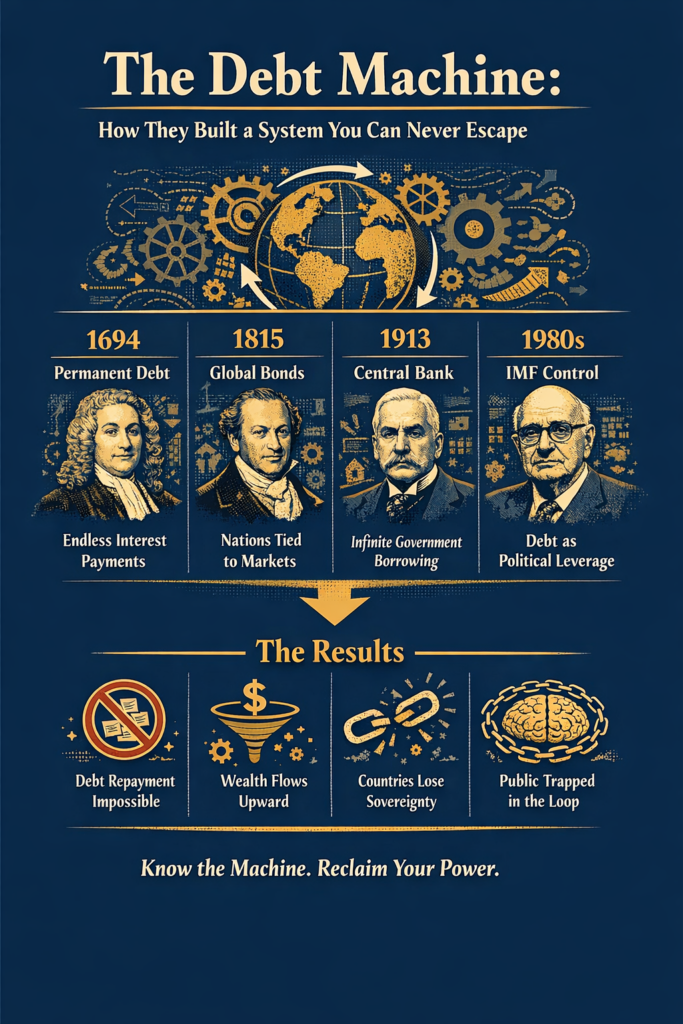
Over three centuries, four foremost financial architects each added a crucial layer to a machine designed not to escape but to be maintained. A machine that feeds on debt, turns governments into clients, and makes entire populations serve as fuel for an endless cycle of borrowing and interest.
The result? A global economy where freedom is an illusion, and perpetual debt is the foundation of our financial reality.
Debt Wasn’t Always the Default
Before the late 1600s, debt was a tool used sparingly. When kings needed money for wars or projects, they borrowed from nobles or merchants. If they defaulted, lenders took the loss. The system was risky—and temporary.
Then in 1694, a Scottish merchant named William Paterson made a revolutionary proposal to the British government: what if the state could borrow money… and never pay it back?
Instead of repaying the principal, the government would pay interest forever. And thus, the Bank of England was born—not as a public institution, but as a privately run mechanism to lend to the crown and collect tax-backed interest from the people.
For the first time in history, national debt became permanent. The idea wasn’t to eliminate debt, but to anchor the economy to it.
This was the birth of modern financial engineering—and the beginning of the debt trap.
Making Debt Transferable: The Rothschild Revolution
Fast forward to the early 1800s.
By now, European powers were copying the British model. Debt had become normal. But it was still limited transactions that were handled directly between governments and wealthy lenders.
That changed when Nathan Rothschild built a financial empire across five European cities. His genius wasn’t just issuing loans—it was creating markets for them.
He transformed government bonds into tradable assets, allowing debts to move across borders and between investors. A French bank could own a bond issued by Britain, sold to a German investor, and used as collateral by an Austrian noble.
This made sovereign debt global, liquid, and systemic. No longer could a government default without risking an international financial domino effect.
It wasn’t just clever finance. It was structural entrapment.
Governments now had no choice but to keep paying. The system was no longer about trust or relationships—it was about keeping the machine from collapsing.
America Joins the Game: Central Banking and Infinite Expansion
In 1913, America entered the chat.
After a devastating financial panic in 1907, the U.S. government created the Federal Reserve System. It was sold to the public as a decentralized, democratic institution. It was designed in secret by bankers—including associates of J.P. Morgan—who wanted a permanent solution to stabilize markets… and ensure infinite liquidity for government borrowing.
Here’s the key shift: the Fed could now create money out of thin air to buy government bonds. This meant that the government would never run out of buyers. It could keep borrowing—forever—and the Fed would absorb the debt using freshly minted dollars.
With this innovation, limits were eliminated. There was no longer a ceiling on how much debt a country could carry. The only absolute requirement was that taxpayers keep covering the interest.
Once again, the public became the engine. Your work, your taxes, your productivity—all funneled upward to serve interest payments on debt that was never meant to end.
The Volcker Trap: Turning Debt into Control
In the 1980s, global debt started to strain the system.
Developing countries that had borrowed heavily during the previous decade were now struggling with interest payments. Then came Paul Volcker, Chairman of the U.S. Federal Reserve.
To curb inflation, he raised interest rates to unprecedented levels—over 20%. This was a death sentence for developing nations, whose dollar-denominated loans became impossible to service.
Countries like Mexico, Brazil, and Argentina couldn’t pay. But instead of allowing defaults, the International Monetary Fund (IMF) stepped in with bailouts—on one condition: governments had to surrender economic control.
Public programs were slashed. State assets were privatized. Currency controls were removed. In exchange for just enough funding to keep making interest payments, these nations effectively handed over economic sovereignty.
This was no longer about finance—it was about leverage.
Debt had become a tool of compliance, used to reshape entire economies and ensure a steady flow of interest to the same Western institutions that built the system in the first place.
The Four Pillars of the Inescapable System
Over 300 years, four key players each laid a brick in the trap:
- William Paterson (1694) – Made government debt permanent
- Nathan Rothschild (1815) – Made it transferable, global, and systemic
- J.P. Morgan (1913) – Enabled infinite borrowing through the Federal Reserve
- Paul Volcker (1982) – Turned default into political surrender
Together, they created a machine that ensures:
- Governments borrow indefinitely
- Taxpayers pay interest eternally
- Defaults are prevented, not forgiven
- Control stays concentrated at the top
It’s not a bug. It’s a feature.
Who Benefits from This System?
When you follow the money, you find a small group of asset managers, banks, and institutions that benefit from every layer of the cycle.
Entities like BlackRock, Vanguard, State Street, and Fidelity manage trillions in global assets. They hold government bonds in pension funds, retirement accounts, and insurance portfolios.
As of now, the U.S. pays over $1 trillion per year just in interest on its national debt. That money doesn’t vanish; it flows upward into these institutions, which are primarily owned by the wealthiest in society.
This is the most significant wealth transfer in history—happening silently, continuously, and structurally.
Why Can’t Governments Pay Off the Debt?
Because the entire money supply depends on it.
In today’s system, new dollars are created when the government borrows. If it stopped borrowing and tried to pay down debt, it would shrink the money supply—causing deflation, recession, and possibly depression.
It’s like draining the gasoline from a running engine.
Governments can’t escape the trap without crashing into the economy. The same goes globally. If all debt were repaid, the system would seize up—there wouldn’t be enough money in circulation.
Debt is no longer a problem. It’s the foundation.
Escaping the Illusion: What This Means for You
If you’re in your 20s, 30s, or even 40s, this may sound overwhelming. The world you’ve inherited is built on rules you didn’t vote for, enforced by systems you don’t fully see.
But awareness is power. And here’s what that means for you:
1. Stop Thinking the System Is Broken
It’s not broken, it’s optimized for control, not fairness. When you stop expecting the machine to serve you, you can start making better personal decisions around it.
2. Redefine Wealth
Don’t chase false security in the form of debt-backed assets or hollow status. Invest in things the system can’t inflate away: skills, health, creativity, and meaningful relationships.
3. Understand Your Leverage
You may not be able to dismantle global finance, but you can stop being a passive fuel source. Make conscious financial decisions. Opt out of unnecessary debt. Learn how money is created.
4. Build Resilience
Real power lies in self-sufficiency. Learn how to live with less, create more, and rely less on systems that exist to extract value from your time and labor.
The Rent We Pay to Exist
In the end, the interest on global debt is more than an economic figure.
It’s the rent we pay to live in someone else’s system.
It’s the silent tax extracted from your work, your taxes, your future. And unless we begin questioning it—not just politically, but philosophically, we’ll remain trapped in a loop built long before we were born.
The architects are long gone. But their design still rules your life.
The question is: now that you see the machine, what will you do differently?
Want to Dive Deeper?
- How is money really created?
- What is sovereign debt, and who controls it?
- Can we design new systems that prioritize people over interest payments?
You won’t learn this in school. But the future will demand that you understand it.
Because only when you see the structure can you begin to build something better.
If you found this article helpful, hit that button, like, and share it with your friends and loved ones. It tells the algorithm that this message matters. And subscribe. But don’t do it for me. Do it to help spread the mindset that one day could save a life.
Let’s build a community of people who aren’t waiting to be rescued. Let’s spread the word and stay one step ahead.
And most importantly, take care of yourself!

Pervaiz Karim
Pervaizrk [@] Gmail.com
Copyright Notice
This article is distributed under the Creative Commons License.
In summary, you may make and distribute copies of this article,
so long as you give the original author credit and, if you alter,
transform, or build upon this work, you distribute the resulting
work only under a license identical to this one.
For the rest of the details of the license,
see http://creativecommons.org/licenses/by-sa/2.0/legalcode