How to Save a Species When There Are Only Two Females Left
A Race Against Time for the Northern White Rhino
A Race Against Time for the Northern White Rhino
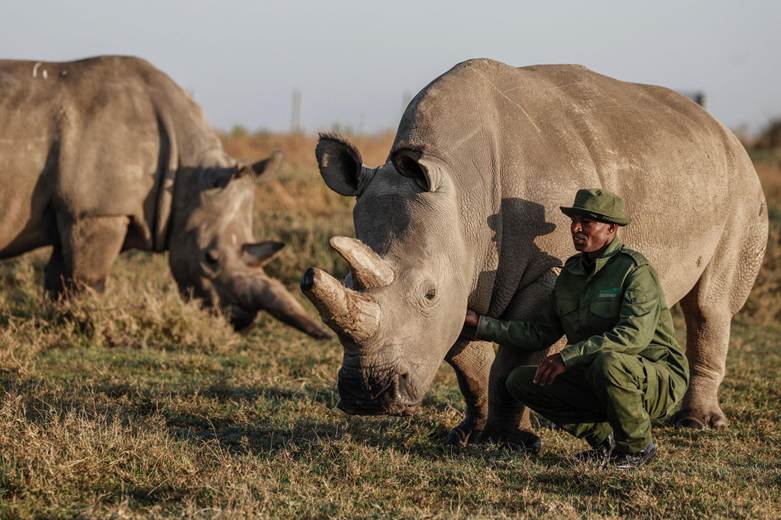
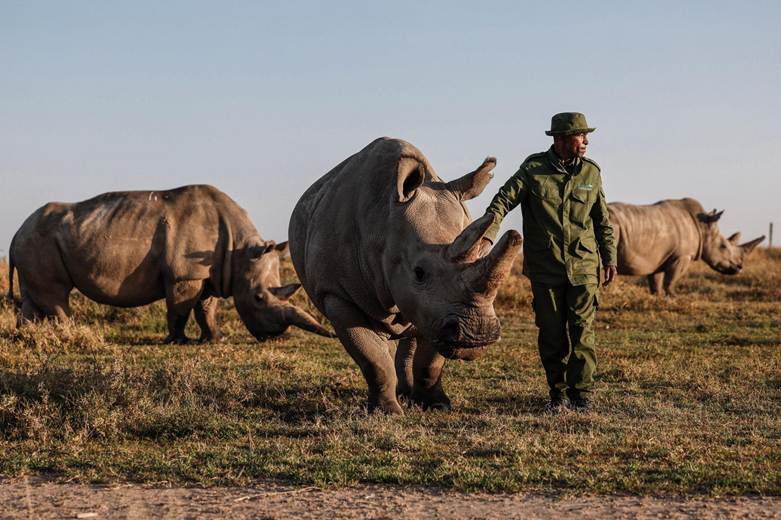
On a quiet stretch of land in Kenya’s Ol Pejeta Conservancy, two massive animals move slowly through the grass.
They look calm. Almost timeless.
Each weighs nearly two tons. Their thick grey skin bears the scars of decades spent on Earth. To the casual observer, they appear like any other rhinos grazing peacefully in the African sun.
But Najin and Fatu are not ordinary animals.
They are the last two northern white rhinos alive on the planet.
And both are female.
That simple fact creates one of the most heartbreaking challenges in conservation: How do you save a species when there are no males left—and the remaining females cannot carry a pregnancy?
For scientists, conservationists, and wildlife lovers around the world, the answer has become a bold and emotional experiment that blends cutting-edge science with deep responsibility.
The story of the northern white rhino is not only about extinction.
It is about humanity trying, against enormous odds, to repair a mistake we helped create.
The Peaceful Giant of Central Africa
For millions of years, rhinos lived relatively peaceful lives.
Their mission, evolutionarily speaking, was simple: eat plants, wander across grasslands, and reproduce.
With few natural predators, rhinos thrived in Africa’s ecosystems.
The northern white rhino, one of two subspecies of white rhinoceros, once roamed the swamps and grasslands of Central Africa in large numbers.
These animals were powerful yet gentle grazers. Their massive bodies shaped wetlands and savannahs as they moved through vegetation, playing a subtle but important role in their ecosystems.
But unlike many other species, the northern white rhino did not face extinction due to natural selection.
It faced extinction because of us.
When Poaching Changed Everything
Roughly fifty years ago, the northern white rhino population began to collapse.
Across Africa, rhinos were hunted relentlessly for their horns. These horns—made of keratin, the same material as human fingernails—became highly valuable in illegal wildlife markets.
Poaching intensified during periods of civil conflict, when wildlife protection weakened and weapons became more widespread.
At the same time, the expansion of human settlements destroyed much of the rhino’s habitat. Within decades, the population crashed.
By 2008, the International Union for Conservation of Nature declared the northern white rhino extinct in the wild.
The species was not completely gone. But it was hanging by a thread.
A Desperate Breeding Effort
Conservationists had already begun trying to save the northern white rhino decades earlier.
In the 1970s, several animals were moved into captivity as part of breeding programs designed to preserve the species. Zoos and wildlife parks across Europe and Africa attempted to help the rhinos reproduce.
Scientists collected and stored semen from male rhinos, hoping future technology might help. But breeding success was rare.
Only a few calves were born.
Among them were Najin and her daughter Fatu, two rhinos born at Safari Park Dvůr Králové in the Czech Republic, who were later transferred to Kenya for conservation efforts. Over time, these two females became the last living representatives of their subspecies.
The Day the Last Male Died
In March 2018, the world watched a quiet moment in conservation history.
Sudan, the last male northern white rhino, died at Ol Pejeta Conservancy after suffering from age-related complications.
His death was mourned globally. With Sudan gone, the northern white rhino became functionally extinct—a term scientists use when a species can no longer reproduce naturally.
The remaining females, Najin and Fatu, faced serious reproductive challenges.
Najin’s hind legs were too weak to support pregnancy.
Fatu’s uterus had a condition that made carrying a calf impossible.
At that moment, it seemed the species had reached its final chapter. But a small group of scientists refused to accept that ending.
The Bio Rescue Project
An international team of experts launched a project called Bio Rescue, led by Professor Thomas Hildebrandt from the Leibniz Institute for Zoo and Wildlife Research.
Their idea was bold. If natural reproduction were impossible, perhaps science could intervene.
Using advanced reproductive technology, they hoped to create northern white rhino embryos in a laboratory.
The process would involve several steps:
- Extract egg cells from the remaining females
- Fertilize the eggs with preserved sperm from deceased males
- Grow embryos in the laboratory
- Implant them into surrogate mothers
If successful, a southern white rhino—an extremely close relative—could carry the pregnancy.
It would be one of the most ambitious conservation experiments ever attempted.
A Medical Procedure Like No Other
Extracting eggs from a rhino is not easy.
Rhinos are enormous animals, weighing close to two tons.
Their reproductive organs lie deep inside their bodies.
To reach them, scientists developed a specialized device nearly two meters long.
During the procedure, the instrument is carefully inserted through the rectum and guided toward the ovaries. A curved needle then extracts immature egg cells from follicles deep within the abdominal cavity.
The process requires extraordinary precision. Veterinarians, reproductive biologists, and engineers must work together closely.
Every procedure is a careful balance between scientific ambition and the well-being of the animals.
From Egg Cells to Embryos
Once collected, the egg cells are flown to a specialized laboratory in Italy called Avantea.
There, scientists attempt to fertilize them using frozen sperm collected years earlier from male northern white rhinos.
The fertilized eggs begin developing into embryos.
But success is rare.
Many embryos fail to develop.
Others stop growing early.
Yet in 2019, something remarkable happened.
Two viable embryos were created.
More followed in the years after.
Today, scientists have successfully produced five northern white rhino embryos. They are preserved in liquid nitrogen at –196°C, where biological activity essentially stops, allowing them to remain viable for decades. Inside those frozen cells lies the possibility of an entire species’ future.
Finding a Surrogate Mother
The next challenge is finding a suitable surrogate.
Northern and southern white rhinos diverged about one million years ago, but they remain genetically close.
Their pregnancies last the same amount of time.
Because of this similarity, scientists believe that a southern white rhino could carry a northern white rhino embryo to term.
If successful, the calf would be genetically northern white.
It would represent the first step in rebuilding the species.
Why Time Matters
Despite the progress, the situation remains urgent.
Najin is over thirty years old and suffers from health issues.
Fatu may still produce eggs for several more years, but scientists cannot predict how long.
The embryos created today depend on knowledge passed down from these two remaining animals. Their behavior, their social interactions, their maternal instincts—all could help guide the next generation.
Without them, even successful births could face challenges.
In conservation, knowledge can be as valuable as genetics.
The Ethics of Resurrection
The Bio Rescue project raises profound questions.
Should humans intervene so dramatically in nature?
Is reviving a species through advanced technology the right approach?
Some critics argue that conservation resources should focus on protecting ecosystems rather than attempting technological rescue missions.
Others believe that because humans caused the northern white rhino’s collapse, we have a responsibility to try everything possible to save it. In truth, both perspectives carry weight.
But what remains undeniable is the emotional power of this effort.
Scientists are not simply conducting experiments. They are trying to repair a loss that once seemed irreversible.
A Lesson for the Future
The northern white rhino did not fail in evolution. It was well adapted to its environment for millions of years. What it could not adapt to was rapid human expansion, illegal wildlife trade, and habitat destruction.
The lesson here is sobering. Species rarely disappear because nature rejects them.
More often, they vanish because humans disrupt the balance they depend on.
Yet the story of Najin and Fatu also offers something else.
Hope.
Even when a species is reduced to just two individuals, people across the world can come together to try something extraordinary.
Standing Guard Over the Last Two
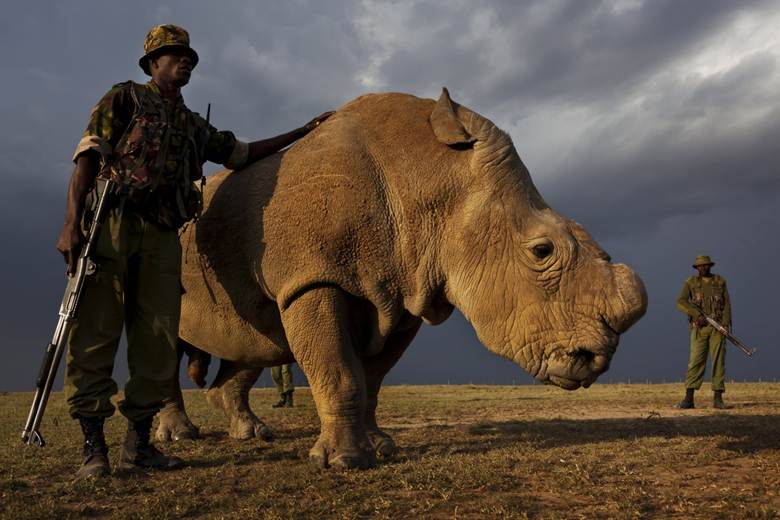
At Ol Pejeta Conservancy, armed rangers guard Najin and Fatu around the clock.
They are protected not just as animals, but as living symbols of conservation’s most urgent mission.
Visitors who see them often describe mixed emotions.
Awe.
Sadness.
And a deep respect for the fragility of life on Earth.
Because these two rhinos represent the edge of extinction—and the edge of possibility.
A Future Not Yet Written
Somewhere in a laboratory freezer, five tiny embryos rest in suspended time.
They are smaller than a grain of rice. Yet within them lies the genetic legacy of a species that once roamed Africa’s wetlands and savannahs.
If scientists succeed, one of those embryos may someday become a calf. And that calf could become the beginning of a new herd.
The northern white rhino’s story is not finished yet.
It is simply waiting for its next chapter.
And whether that chapter becomes a tragedy or a triumph may depend on the choices we make today.
If you find this article helpful, hit that button, like, and share it with your friends and loved ones. It tells the algorithm that this message matters. And subscribe. But don’t do it for me. Do it to help spread the mindset that one day could help a friend or a loved one.
Let’s build a community of people who aren’t waiting to be rescued. Help spread the word and stay one step ahead.
And most importantly, take care of yourself!

Pervaiz Karim
https://NewsNow.wiki
PervaizRK [@] Gmail.com
Copyright Notice
This article is distributed under the Creative Commons License.
In summary, you may make and distribute copies of this article,
so long as you give the original author credit and, if you alter,
transform, or build upon this work, you distribute the resulting
work only under a license identical to this one.
For the rest of the details of the license,
see http://creativecommons.org/licenses/by-sa/2.0/legalcode